
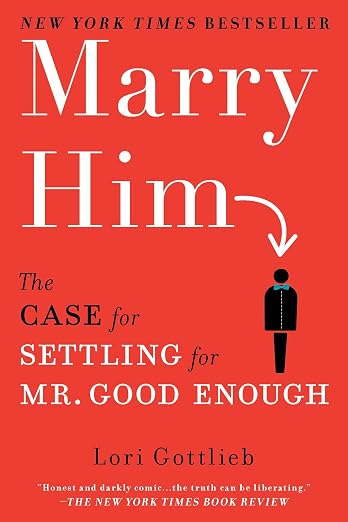
Marry Him: The Case for Settling for Mr. Good Enough by Lori Gottlieb (2011, 321 pages) This insightful work serves as a practical “dating public service announcement” (p. 312), urging readers to adjust their perspectives to make the search for a partner more interesting, manageable, entertaining, and less disappointing (p. 313). Rather than relying on rigid expectations, the author emphasizes that long-term compatibility relies heavily on respect, shared values, and building a life together rather than judging imperfections (p. 98).
A central theme of the book is the danger of setting overly narrow criteria. When individuals insist they will “not settle,” the book counters with a different approach: “broaden your fantasies” (p. 105). Holding onto rigid expectations limits possibilities, whereas letting go of preconceived notions opens the door to falling in love with someone unexpected (p. 106). How much should people change to make a relationship work? (p. 175) It’s one thing for your partner to accept your interest; it’s another way to ask them to feel the way that you do about them. And the more requirements you have, the lower the percentage goes (p. 110).
The book also tackles the reality of long-term relationships versus romantic ideals. Grounding the narrative in practical wisdom, marriage is described not as a constant passion-fest, but as “a partnership formed to run a very small, mundane nonprofit business” (p. 227). Citing Goethe, the text reminds us that “love is an ideal thing, marriage a real thing; a confusion of the real with the ideal never goes unpunished” (p. 213). Furthermore, referencing Friedrich Nietzsche, the author points out that “it’s not lack of love, but lack of friendship that makes unhappy marriages” (p. 271).
Key takeaways and reflective questions explored throughout the text include:
– Evaluating First Impressions: How much stock should we really put in first dates (p. 190), and how practical should we be in our search for love (p. 225)?
– Focusing on Longevity: While people often ask how couples met, few ask the more important question: how do they stay together (p. 193)? Real love develops over time through trust, bonding, and shared growth, rather than starting at an unsustainably high peak (p. 201–202).
– Conflict Resolution: Success in a relationship isn’t defined by whether you argue, but by how you get through the arguments together (p. 247).
– Rethinking Checklists: Instead of maintaining an exhaustive list of desired traits in a future partner, it is far more revealing to examine past relationships and see how little those checklists actually mattered in the end (p. 268).
Ultimately, the book offers a grounded, refreshing perspective on modern romance, encouraging readers to balance practicality with open-mindedness in their search for lasting partnership. While the “clickbait” title doesn’t do the book justice, it clearly worked for this national bestseller. My main critique is that it badly needs an index or reference page. The author consults so many fantastic researchers whose work I wanted to dive deeper into, but there were too many to flag myself. That said, this book is chock-full of incredible soundbites and truths—so many, in fact, that they inspired this entire review! I recommend this book if you have been married for the last five presidents (it’s a great topic of discussion) or newly dating or looking to refine your dating.

